Wrist support is a common requirement across sports, fitness, rehabilitation-oriented products, physical activity, and everyday movement. For businesses supplying sports tape, athletic tape, kinesiology tape, or related support products, the wrist presents a particularly demanding application area. The joint is constantly involved in gripping, lifting, pushing, pulling, rotation, and repetitive hand movements. A tape designed for the wrist therefore needs to balance support, elasticity, adhesion, comfort, flexibility, and ease of application.
For distributors, importers, sports brands, rehabilitation product companies, fitness suppliers, and retailers, selecting the right kinesiology tape for wrist support involves more than comparing tape width or adhesive strength. Product construction, elastic recovery, skin contact, backing material, adhesive performance, roll dimensions, packaging, and application requirements can all influence whether a tape is suitable for a specific market.
This guide explains the practical factors B2B buyers should consider when evaluating kinesiology tape for wrist applications. It also covers common product specifications, application considerations, purchasing questions, quality-control points, and customization options that can help businesses develop a more reliable tape product line.
Why the Wrist Requires a Flexible Support Tape
The wrist is not a simple hinge joint. It allows multiple movements, including flexion, extension, radial deviation, ulnar deviation, and rotational movement associated with the forearm and hand. During sports and physical work, these movements can occur repeatedly and sometimes under load.
A rigid adhesive tape can provide a strong level of restriction, but it may also interfere with normal movement when used for applications that require flexibility. This is one reason elastic kinesiology tape has become a popular category for sports and activity-related support.
A suitable wrist tape needs to stay attached while the wrist changes position. When the hand moves, the skin around the wrist also stretches and compresses. If the tape cannot accommodate this movement, it may wrinkle, lift at the edges, or create an uncomfortable feeling.
For B2B buyers, this means that the phrase "wrist support tape" alone does not provide enough information to evaluate a product. The actual construction and performance characteristics should be examined.
A practical evaluation should consider:
Elasticity and stretch behavior
Recovery after stretching
Adhesive tack
Adhesive consistency
Backing material
Fabric structure
Thickness
Breathability
Edge performance
Skin-contact characteristics
Resistance to sweat and moisture
Ease of tearing or cutting
Available widths and lengths
Packaging options
Custom printing and branding requirements
These factors become particularly important when the tape is intended for repeated use during training, competition, outdoor activities, or demanding work environments.
What Is Kinesiology Tape for Wrist Support?
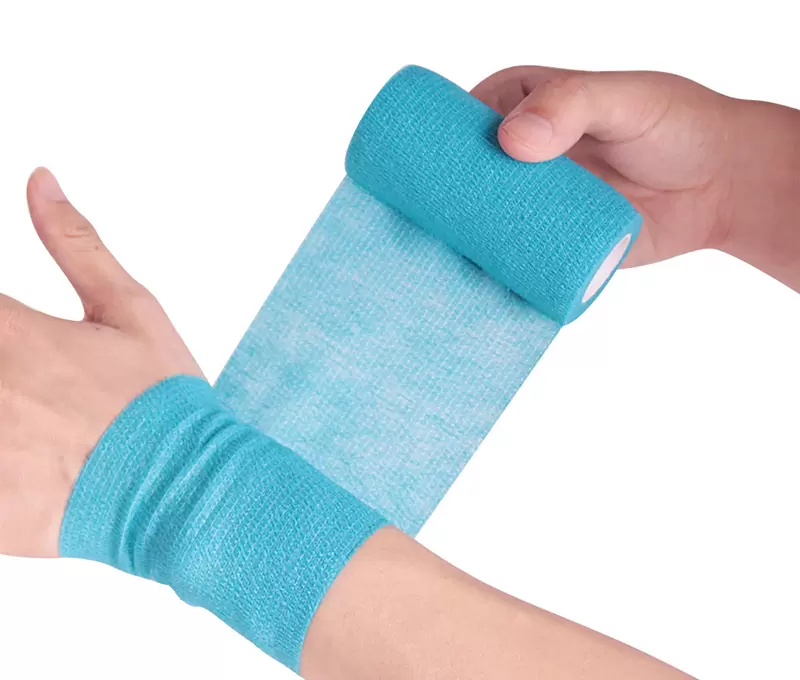
Kinesiology tape is generally an elastic adhesive tape designed to conform to body contours while allowing a degree of movement. Unlike conventional rigid athletic tape, elastic tape can move with the skin and body.
When used around the wrist, kinesiology tape can be configured in different application patterns depending on the intended use and the preferences of the person applying it. The tape can be cut into strips or applied in different shapes to follow the wrist and forearm.
From a product-development perspective, the most important characteristic is not simply whether a tape stretches. The tape needs controlled elasticity.
If a tape stretches too easily, it may be difficult to position accurately and may not provide the handling characteristics expected by the user. If it is too rigid, it may not conform well to the wrist during movement.
For this reason, B2B customers should request actual technical specifications rather than relying only on marketing descriptions such as "high elasticity" or "strong adhesion."
Useful specifications may include:
The exact specifications required will depend on the target application and market.
Key Product Characteristics Buyers Should Evaluate
1. Elasticity
Elasticity is one of the defining features of kinesiology tape. For wrist applications, the tape should generally have enough stretch to follow movement without becoming difficult to control.
The useful question for a buyer is not simply "How elastic is the tape?" Instead, consider how the tape behaves before, during, and after application.
A procurement team can evaluate:
How easily the tape stretches by hand
Whether the stretch is consistent across the roll
Whether it returns toward its original dimensions
Whether stretching changes adhesive performance
Whether the fabric deforms permanently after repeated handling
Whether the tape remains comfortable when the wrist bends
Consistency is particularly important for commercial products. A tape that performs differently from one batch to another can lead to customer complaints and inconsistent user experiences.
2. Adhesion
Adhesion is another critical factor in kinesiology tape for wrist support.
The tape needs sufficient adhesion to remain in position during movement, but excessive initial tack is not automatically better. If the tape is difficult to reposition during application, users may struggle to achieve accurate placement.
A good commercial tape should be evaluated for both initial tack and adhesion retention.
Buyers should consider how the adhesive behaves under:
Normal body movement
Perspiration
Increased humidity
Extended wear
Friction from clothing
Repeated wrist movement
Outdoor conditions
The adhesive should also be applied consistently across the tape width. Uneven coating can produce areas that lift prematurely or feel different during application.
For private-label or customized products, adhesive selection should be discussed with the tape supplier before finalizing the product specification.
3. Fabric and Backing Material
The backing material determines many of the physical characteristics of kinesiology tape.
Common elastic tape constructions use textile materials that provide flexibility and controlled stretch. Depending on the product design, materials may include cotton-based fabrics, synthetic fibers, blends, or other specialty textile structures.
The choice affects:
Stretch behavior
Hand feel
Breathability
Surface texture
Tearability
Printing performance
Moisture management
Durability
Cost structure
For wrist applications, the fabric should conform to a relatively small and continuously moving area. A bulky or excessively stiff backing may be less convenient than a flexible construction.
For B2B buyers, the best material should be selected according to the target market rather than using one material for every product.
A sports retailer may prioritize comfort and appearance. A professional sports supplier may place greater emphasis on consistent performance. A distributor serving multiple customer groups may require several product grades.
4. Thickness
Tape thickness is sometimes overlooked during sourcing, but it affects handling and user experience.
A thinner tape may feel less noticeable during movement and can be easier to position around compact anatomical areas. A thicker construction may offer a different tactile feel and potentially different durability characteristics.
Neither is automatically better.
When evaluating a wrist tape, buyers should consider whether the product needs to fit comfortably around the wrist without creating excessive bulk. The tape should also work with the intended application technique and packaging format.
Instead of selecting thickness solely according to a supplier's standard specification, buyers can request samples and compare several constructions under actual use conditions.
5. Breathability and Moisture Management
The wrist can become exposed to sweat during training, running, cycling, weightlifting, racket sports, and other activities.
A tape that remains comfortable in dry conditions may behave differently when exposed to moisture. Sweat can affect the adhesive interface and may also change the feel of the backing.
Breathability therefore becomes a relevant consideration for sports-oriented products.
B2B buyers should evaluate:
Fabric air permeability where relevant
Moisture exposure performance
Adhesive retention during perspiration
Drying behavior
Surface comfort
Edge lifting after activity
These tests should be performed under controlled conditions whenever possible. Casual testing by one person can provide useful feedback, but it should not replace a repeatable quality-control process.
Wrist Applications Across Different Sports
A major advantage of elastic wrist tape is its versatility. Different sports place different demands on the wrist, so product positioning should be based on actual use conditions rather than generic sports terminology.
Weight Training and Strength Training
Weightlifting and strength training involve repeated gripping and wrist loading. Athletes may also wear wrist wraps or rigid support products depending on their training requirements.
Elastic kinesiology tape can serve a different purpose within a sports-support product category. Its flexibility makes it suitable for users who want a tape that follows wrist movement rather than creating a rigid wrap.
For B2B suppliers, this market may favor products that are:
Flexible
Easy to apply
Comfortable during repetitive movement
Available in multiple colors
Conveniently packaged
Suitable for personal application
Packaging can be important because many fitness consumers purchase tape as a portable training accessory.
Tennis and Badminton
Racket sports require repeated wrist and forearm movement. Players frequently move between gripping, swinging, and rapid directional changes.
A wrist tape product for this market should be evaluated for flexibility and adhesive retention. The tape should not easily loosen as the user sweats or repeatedly moves the wrist.
Distributors targeting racket sports can also consider packaging that clearly explains intended use, tape dimensions, and application instructions.
Golf
Golf involves repeated grip and wrist movement, although the movement pattern differs from high-frequency racket sports.
A product line can be positioned around sports support, grip-related comfort, or general activity depending on the market strategy and applicable product claims.
For businesses already supplying golf-related adhesive products, wrist tape can complement other tape categories and create opportunities for bundled offerings.
Running and Outdoor Fitness
Running generally involves less direct wrist loading than weight training, but runners may still use support products for various personal reasons.
For this segment, comfort, low-profile construction, sweat resistance, and convenience may be more important than heavy-duty adhesion.
Outdoor users may also encounter higher humidity, rain, dust, and temperature variation. These environmental conditions should be considered when evaluating tape performance.
Volleyball and Team Sports
Team sports often involve repeated arm and wrist movement, contact with equipment, perspiration, and extended activity.
For distributors supplying sports teams, the purchasing model may differ from consumer retail. Bulk rolls, consistent color options, private-label packaging, and predictable batch quality can become more important.
A B2B supplier should therefore be prepared to discuss both technical specifications and commercial packaging requirements.
How Tape Width Influences Wrist Applications
Tape width is a practical specification that should not be selected independently of the intended application.
The wrist is relatively compact compared with larger body areas such as the thigh, back, or shoulder. A very wide tape may require additional cutting, while a narrow tape may require several strips to achieve the desired coverage.
Different customers may prefer different widths based on their application methods.
For a B2B product portfolio, offering multiple widths can make the range more flexible. However, additional SKUs also increase inventory complexity.
Before introducing multiple sizes, buyers should analyze:
Main target markets
Typical application methods
Retail packaging requirements
Distributor preferences
Shipping dimensions
Stock-keeping requirements
Minimum order quantities
Labeling needs
The most commercially useful configuration is often the one that balances application convenience with inventory simplicity.
Choosing the Right Adhesive System
Adhesive formulation is a major part of tape performance. Two tapes with similar fabric structures can behave very differently because of differences in adhesive chemistry and coating.
For sports tape applications, the adhesive needs to maintain an appropriate balance between tack and wear performance.
B2B buyers should ask suppliers:
What type of adhesive is used?
Is the adhesive coating uniform across the roll?
What conditions were used for adhesion testing?
How does the adhesive perform under moisture exposure?
What are the recommended storage conditions?
How long can the product be stored before use?
Are adhesive specifications controlled from batch to batch?
Can adhesive characteristics be adjusted for different applications?
These questions are more useful than simply asking whether the product has "strong glue."
A supplier with an established adhesive-tape production system should be able to explain how raw materials, coating, curing, slitting, inspection, and packaging affect the final product.
The Importance of Edge Adhesion
Edge lifting is a common practical concern with adhesive tape.
Even when the central portion of the tape remains attached, an edge can begin to peel because of friction, moisture, movement, or inadequate surface preparation.
For wrist applications, edge performance deserves particular attention because the tape may experience frequent bending and contact with clothing or equipment.
Quality testing can include observation of:
Edge lifting after application
Adhesion after repeated wrist movement
Performance after sweating
Tape behavior during bending
Removal characteristics after the intended wear period
Suppliers should establish repeatable test methods rather than relying entirely on visual inspection.
Skin Contact and User Comfort
Because kinesiology tape is applied directly to skin, comfort is a major product consideration.
However, buyers should avoid treating all skin-contact products as interchangeable. Different adhesive systems and backing materials can produce different user experiences.
Commercial products should provide appropriate instructions and warnings based on the product specification and applicable market requirements.
A responsible product-development process can include evaluation of:
Adhesive formulation
Fabric softness
Surface texture
Removal characteristics
User comfort
Storage stability
Packaging integrity
For products intended for international distribution, regulatory and labeling requirements should be reviewed for each destination market.
Application Preparation Matters
Even a well-designed kinesiology tape for wrist support can perform poorly if the application surface is not properly prepared.
The skin should generally be clean and dry before application. Oils, lotions, heavy perspiration, and other contaminants can interfere with adhesive contact.
Hair, moisture, and friction can also influence adhesion.
From a B2B perspective, this is important because product instructions should not only describe where to place the tape. They should also explain basic preparation and handling.
Simple instructions can reduce avoidable complaints.
For example, packaging may provide guidance on:
Cleaning and drying the application area
Avoiding application over wet or oily skin
Rubbing the tape gently after application when appropriate
Avoiding excessive handling of the adhesive surface
Removing the tape carefully
Discontinuing use if significant skin discomfort occurs
Specific instructions should match the actual product design and should be validated by the company responsible for the finished product.
Common Sourcing Mistakes in B2B Tape Purchasing
Many sourcing problems occur because buyers focus on one specification instead of evaluating the entire product.
Mistake 1: Choosing Only by Price
A low unit cost does not necessarily produce a lower total procurement cost.
If adhesive performance is inconsistent, rolls may be rejected or returned. If dimensions vary, packaging operations can become more difficult. If the backing material changes between batches, customer complaints may increase.
A better purchasing evaluation considers total quality and consistency.
Mistake 2: Comparing Elasticity Without a Standard
Different suppliers may use different testing methods when describing stretch.
A claim such as "high elasticity" has limited value unless the test method and specification are understood.
Buyers should request measurable technical information and, where possible, compare samples using the same testing conditions.
Mistake 3: Ignoring Adhesive Uniformity
A tape can look acceptable while still having coating variations.
Uneven adhesive application may cause inconsistent tack across the roll. Commercial buyers should therefore ask how coating weight and coating uniformity are controlled.
Mistake 4: Testing Only One Roll
One sample roll does not necessarily represent production consistency.
For larger orders, buyers should establish a sample approval process and then define the production specifications that the supplier must maintain.
Mistake 5: Forgetting Packaging Requirements
Packaging affects retail presentation, storage, transportation, and labeling.
A technically good tape may still be unsuitable for a customer's distribution channel if the packaging dimensions, labels, barcodes, instructions, or carton configuration do not match the customer's requirements.
A Practical B2B Evaluation Process
A structured evaluation process can make supplier selection more efficient.
Step 1: Define the Target Application
Before contacting suppliers, identify the intended use.
For example:
The intended market determines which specifications deserve the greatest attention.
Step 2: Establish Technical Requirements
Create a basic specification sheet covering:
Tape material
Width
Length
Elasticity
Adhesive type
Color
Printing
Packaging
Roll core
Individual packaging
Carton configuration
Not every project requires the same level of detail, but a written specification reduces misunderstandings.
Step 3: Request Samples
Samples should be evaluated under realistic conditions.
Check:
Application handling
Stretch behavior
Adhesion
Comfort
Edge performance
Removal
Packaging
Printing quality
Where possible, multiple users should evaluate the samples.
Step 4: Compare Production Samples
Once a product specification has been selected, ask for production-representative samples rather than relying exclusively on development samples.
This helps determine whether the supplier can reproduce the approved specification consistently.
Step 5: Confirm Quality Control
Ask how the supplier controls:
A mature production system should have defined checkpoints throughout the process.
Private Label and Custom Tape Development
For B2B customers, the opportunity may extend beyond buying standard rolls.
Custom tape programs can include:
The feasibility of each option depends on order volume, material availability, printing technology, and production requirements.
When developing a private-label kinesiology tape for wrist support, buyers should finalize the technical specification before investing heavily in packaging design.
This prevents a common problem: creating retail packaging around a product specification that later changes during testing.
A better sequence is:
Application definition → sample development → technical approval → production confirmation → packaging design → mass production.
This approach can reduce unnecessary revisions.
What a Supplier Should Be Able to Discuss
A professional adhesive tape supplier should be able to discuss more than product dimensions.
For a wrist kinesiology tape project, useful supplier capabilities include knowledge of:
For buyers developing several tape categories, an integrated production chain can also simplify procurement.
Instead of coordinating separate suppliers for fabric, adhesive coating, slitting, printing, and packaging, a supplier with broader internal capabilities may be able to manage more of the process under one production system.
This can improve communication and reduce the number of interfaces between different vendors.
Quality Control for Commercial Wrist Tape
Quality control should be defined before mass production.
A basic QC program may include incoming-material inspection, in-process checks, and finished-product inspection.
Incoming Materials
Materials should be checked against approved specifications.
Potential inspection items include:
Fabric type
Fabric weight
Elasticity
Adhesive raw materials
Packaging materials
Printing materials
In-Process Inspection
During production, relevant parameters should be monitored.
Depending on the production process, this may include:
Coating uniformity
Tape width
Tape thickness
Roll winding
Adhesive condition
Printing registration
Slitting accuracy
Finished Product Inspection
Finished rolls can be inspected for:
Dimensions
Appearance
Adhesion characteristics
Elasticity
Packaging
Label accuracy
Roll integrity
Visible defects
The exact inspection plan should be based on the product specification and intended market.
Storage and Logistics Considerations
Adhesive products are sensitive to storage conditions. Temperature, humidity, direct sunlight, packaging integrity, and storage duration can affect product performance.
B2B buyers should request supplier recommendations for:
This information should be incorporated into warehouse procedures.
For international buyers, logistics planning also matters because adhesive tape can be shipped in different configurations depending on roll dimensions and packaging.
A supplier with an established production and logistics system can help coordinate order preparation, carton packing, labeling, and shipment scheduling.
Why Production Consistency Matters More Than a Single Excellent Sample
One of the most important distinctions between product development and commercial procurement is repeatability.
A supplier may provide an excellent sample, but the real test is whether the same performance can be reproduced across large production quantities.
For a B2B customer, consistency affects:
This is why supplier evaluation should include both product testing and production-system evaluation.
A buyer should ask what controls are in place to keep the approved product specification stable.
Building a Multi-Product Sports Tape Portfolio
Companies that already sell sports tape may benefit from developing a broader product portfolio.
For example, a product range could include:
Each product serves a different function and customer segment.
From a procurement perspective, working with a supplier capable of supporting several adhesive tape categories can simplify supplier management and product development.
It may also make it easier to maintain consistent packaging standards and brand identity across the product portfolio.
Questions to Ask Before Placing a Large Order
Before moving from sample testing to commercial procurement, buyers should have clear answers to the following questions:
What is the exact backing material?
The supplier should provide a defined material specification rather than a broad description.
What is the adhesive type?
Understand whether the adhesive system matches the intended application and market requirements.
What are the tape dimensions?
Confirm width, length, thickness, roll core, and tolerance.
What is the elasticity specification?
Ask how elasticity is measured and under what test conditions.
How is adhesive consistency controlled?
Understand the supplier's coating and inspection process.
What packaging formats are available?
Confirm individual packaging, labeling, cartons, barcodes, and other requirements.
Can the tape be customized?
Ask about colors, printing, sizes, lengths, and packaging.
What is the minimum order quantity?
MOQ affects inventory investment and the feasibility of customized products.
How are production batches controlled?
Batch traceability can be valuable for commercial customers.
What quality documents are available?
The appropriate documentation depends on the product and target market.
These questions can help procurement teams compare suppliers using objective criteria rather than sales claims alone.
How Xingda New Material Approaches Adhesive Tape Supply
Xingda New Material focuses on the development, production, and sales of multiple adhesive tape categories, including sports-related tapes and specialty adhesive products.
Its product range covers Sport Tape, Kinesiology Tape, Athletic Tape, Sport Bandage, Duct Tape, cloth-based adhesive tape, fiber mesh double-sided adhesive tape, Kraft paper adhesive tape, golf grip double-sided adhesive tape, and customized special adhesive tapes.
This broader product scope is relevant to B2B customers that need more than a single tape SKU.
The company also develops special materials for coating, gluing, and OEM applications, allowing customers to discuss product requirements beyond standard catalog specifications.
For customers sourcing kinesiology tape for wrist support, this type of production capability can be useful when the project requires adjustments to tape construction, dimensions, packaging, or other commercial specifications.
The company operates in Dongguan, Guangdong, with access to regional freight infrastructure and water and land transportation. Its integrated production chain is designed to support efficient order processing and shipment coordination.
For international buyers, logistics capability should be evaluated together with product quality because delivery performance becomes increasingly important when managing overseas inventory.
When Standard Tape Is Enough and When Customization Makes Sense
Not every buyer needs a customized tape.
Standard products are often the better choice when:
The required specification is already available
The buyer is testing a new market
Order quantities are relatively small
Speed to market is important
Standard packaging is acceptable
Customization becomes more useful when:
A brand needs differentiated colors
A distributor wants private-label packaging
A retailer requires specific roll dimensions
A sports organization needs branded tape
A company has a specific adhesive requirement
The standard product does not meet an application requirement
The key is to avoid customization simply for the sake of customization. Every additional specification can affect production complexity, lead time, MOQ, and quality control.
Creating a Product Specification Sheet
For professional purchasing teams, a product specification sheet can make supplier communication much more efficient.
A useful specification sheet may include:
Product name: Kinesiology Tape for Wrist Support
Application: Sports and activity-related wrist taping
Backing: Approved elastic textile construction
Width: Customer-defined
Length: Customer-defined
Elasticity: Supplier specification with defined test method
Adhesive: Approved adhesive system
Color: Standard or customized
Printing: None or customized
Packaging: Individual roll, box, pouch, or other approved format
Labeling: Customer requirements
Carton: Defined quantity per carton
Inspection: Agreed QC criteria
The actual technical values should be confirmed during product development rather than copied from a generic template.
How to Compare Multiple Suppliers
A supplier comparison matrix can make procurement decisions more objective.
Consider assigning evaluation categories such as:
| Evaluation Area | Key Question |
|---|
| Product construction | Does the backing meet the application requirement? |
| Elasticity | Is stretch performance consistent? |
| Adhesion | Does the adhesive maintain contact under intended conditions? |
| Comfort | Is the tape suitable for prolonged activity? |
| Dimensions | Are width and length controlled within agreed tolerances? |
| Quality control | Are inspection procedures clearly defined? |
| Customization | Can the supplier support required branding and packaging? |
| Production capability | Can the supplier meet the expected volume? |
| Logistics | Can shipments be prepared and dispatched efficiently? |
| Communication | Can technical requirements be discussed clearly? |
This approach prevents procurement decisions from being based entirely on unit price.
Understanding the Difference Between Product Claims and Product Specifications
Search results and supplier catalogs often contain phrases such as "strong support," "premium adhesive," "high elasticity," or "professional sports tape."
These descriptions may be useful for marketing, but they are not substitutes for technical specifications.
A B2B buyer should translate marketing language into measurable questions.
For example:
"High elasticity" → What is the elongation range and test method?
"Strong adhesion" → Under what conditions is adhesion measured?
"Water resistant" → What moisture exposure test was used?
"Long-lasting" → What duration and test conditions support the claim?
"Premium fabric" → What is the exact material composition and weight?
This process helps procurement teams compare products on a more reliable basis.
Application Instructions and Customer Education
A quality product can still generate complaints if customers do not understand how to use it.
Packaging and product pages should provide clear information about application and removal.
For B2B brands, this is especially important because the manufacturer may not communicate directly with the final consumer. The distributor or retailer may rely heavily on the information supplied with the product.
Useful educational content can cover:
Skin preparation
Tape cutting
Positioning
Stretch handling
Edge finishing
General removal
Storage
Product limitations
Instructions should be written in clear language and should avoid unsupported medical claims.
For international distribution, multilingual packaging may also be appropriate depending on the destination market.
Avoiding Unsupported Medical Claims
This point is important for businesses selling kinesiology tape online.
A product description should distinguish between describing a tape's physical characteristics and making medical or therapeutic claims.
Statements about elasticity, adhesion, flexibility, material construction, dimensions, and intended sports use are generally product characteristics.
Claims about diagnosing, treating, preventing, or curing specific medical conditions may involve additional regulatory considerations depending on the market and the product's intended use.
B2B buyers should therefore coordinate product claims, labeling, packaging, and marketing language with the applicable regulatory requirements in their target market.
A supplier can provide technical information about the tape, but the finished-product brand owner remains responsible for ensuring that its market claims and labeling are appropriate.
Why Sample Testing Should Reflect Real Use
Laboratory measurements are useful, but practical testing can reveal issues that specifications do not immediately show.
For a wrist tape, testing can include:
Apply the tape to clean, dry skin.
Evaluate the ease of positioning.
Move the wrist through normal ranges of movement.
Observe the tape during activity.
Check edge lifting.
Assess comfort.
Observe adhesive performance after perspiration.
Remove the tape and inspect the skin and tape condition.
Record results using the same criteria for each sample.
This does not replace formal product testing, but it can help buyers identify practical differences between competing samples.
A Better Way to Plan a Wrist Tape Product Launch
A B2B company preparing to launch a new wrist kinesiology tape can divide the project into several stages.
Stage 1: Market Definition
Identify the target customer and intended application.
Stage 2: Technical Specification
Define material, elasticity, dimensions, adhesive, color, and packaging.
Stage 3: Supplier Sampling
Request samples from qualified suppliers.
Stage 4: Performance Evaluation
Compare samples under standardized and practical conditions.
Stage 5: Packaging Development
Create the final packaging after the product specification is approved.
Stage 6: Production Approval
Confirm the production sample and quality-control requirements.
Stage 7: Commercial Production
Proceed with the agreed specifications and inspection process.
Stage 8: Post-Launch Feedback
Track customer feedback, product returns, packaging issues, and repeat-order requirements.
This process is generally more efficient than selecting a product based only on a catalog image and price quotation.
Frequently Asked Questions
What is kinesiology tape for wrist support used for?
Kinesiology tape is an elastic adhesive tape designed to conform to the body while allowing movement. Wrist applications are common in sports and physical activity contexts where users want a flexible tape rather than a rigid wrap.
Is kinesiology tape the same as athletic tape?
No. Traditional athletic tape is often designed with a relatively rigid construction, while kinesiology tape is generally elastic. The two products have different physical characteristics and application approaches.
What should B2B buyers check first?
Start with the intended application, then evaluate backing material, elasticity, adhesive characteristics, dimensions, packaging, quality control, and customization requirements.
Does stronger adhesion always mean better wrist tape?
Not necessarily. Adhesive performance should be balanced with application handling, comfort, intended wear conditions, and removal characteristics.
Can wrist kinesiology tape be customized?
Depending on the supplier's capabilities, customization may include dimensions, colors, printing, roll length, packaging, and other product specifications.
How should suppliers demonstrate product consistency?
They should be able to provide defined product specifications, quality-control procedures, production controls, and representative samples. For larger projects, buyers should establish approved specifications and inspection criteria before mass production.
What packaging options can B2B buyers consider?
Options may include individual rolls, printed boxes, pouches, multi-roll packs, customized labels, instruction inserts, and shipping cartons. The appropriate configuration depends on the distribution channel.
How important is supplier production capability?
It is important when the product will be purchased repeatedly or in significant quantities. A supplier needs to reproduce the approved specification consistently rather than simply provide a good initial sample.
Final Considerations for B2B Buyers
Selecting kinesiology tape for wrist support should be treated as a product-engineering and procurement decision rather than a simple tape purchase.
The wrist requires a tape that can accommodate movement while maintaining appropriate adhesion and comfort. Elasticity, adhesive performance, backing material, thickness, dimensions, edge behavior, and moisture exposure should all be considered together.
For B2B customers, the evaluation should go one step further. A commercially viable tape also needs consistent production, reliable quality control, suitable packaging, clear specifications, customization options where necessary, and dependable logistics.
The most useful sourcing strategy is therefore straightforward: define the application first, establish measurable specifications, test representative samples, confirm production consistency, and only then finalize the commercial order.
Xingda New Material supports a broad range of adhesive tape applications, from sports and kinesiology tapes to athletic tape, sport bandages, duct tape, double-sided adhesive products, and customized special tapes. For businesses developing or expanding a sports tape portfolio, discussing the intended application and required specifications at the beginning of the project can make the sourcing process more efficient and help create a product that is easier to manufacture, distribute, and sell.
For a wrist-support tape project, the goal should not simply be to find a tape that sticks. The goal is to identify a repeatable tape construction that matches the application, satisfies the target market, and can be supplied consistently at commercial scale.