Facial appearance products are no longer limited to creams, serums, masks, and cosmetic tools. Adhesive-based beauty products have become an increasingly practical category for brands looking to offer temporary facial contour enhancement without adding a complicated application process. Among these products, facial contour lifting tape is designed to provide mechanical support to selected areas of the face while remaining discreet enough for daily use, makeup applications, photography, events, and other short-term beauty routines.
For B2B buyers, however, selecting facial tape is more complicated than comparing the appearance of finished samples. The performance of the final product depends on the combination of substrate, adhesive, thickness, stretch direction, release liner, die-cutting, packaging, and application design. A tape that performs well in one facial area may not be appropriate for another. Likewise, a material that provides strong adhesion may not deliver the skin comfort expected from a cosmetic product.
This is why product developers, beauty brands, distributors, and private-label businesses need to evaluate facial contour lifting tape as a complete material system rather than simply as a roll of adhesive tape.
For companies sourcing from China or developing a new facial tape product line, understanding these technical factors can make sample evaluation more efficient, reduce unnecessary reformulation, and help establish more consistent product specifications.
What Is Facial Contour Lifting Tape?
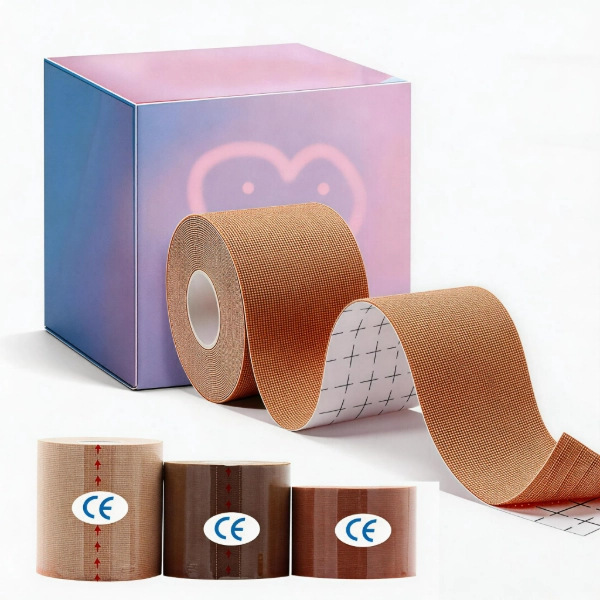
Facial contour lifting tape is a cosmetic adhesive tape designed to temporarily support and visually enhance selected facial contours. Unlike skincare products that work through topical ingredients, the tape relies primarily on physical positioning and adhesive fixation.
The basic principle is straightforward. A properly selected tape is applied to the skin and attached in a direction that creates a controlled lifting or smoothing effect. Depending on the application technique, the tape can be positioned around the jawline, cheeks, forehead, brow area, or other facial zones.
The effectiveness of the finished product is determined by several factors:
The elasticity and recovery of the backing material
The thickness and flexibility of the tape
Adhesive tack and holding power
Skin compatibility of the adhesive
Breathability of the construction
The direction in which the tape is applied
The shape and size of the finished patch
The release liner and die-cutting quality
The user's application technique
A good facial tape therefore needs to balance adhesion with comfort. Excessively aggressive adhesion may make removal uncomfortable, while insufficient adhesion can cause the tape to lift prematurely.
For B2B buyers, this balance is one of the most important points to evaluate before moving from sampling to volume production.
Why Facial Tape Requires Different Material Considerations
Facial skin presents different requirements from areas such as the knee, shoulder, wrist, or back. The skin is exposed, frequently moving, and often more sensitive to adhesive products. In addition, consumers are more likely to notice the visual appearance of a tape used on the face.
A sports support tape may prioritize tensile strength and strong fixation. A facial tape usually needs a different combination of properties.
The product should be thin enough to reduce visibility, flexible enough to follow facial movement, and adhesive enough to remain attached during the intended wearing period. The surface should also be compatible with common cosmetic products if the tape is intended to be worn underneath or together with makeup.
This makes substrate selection particularly important.
Xingda New Material's face lifting tape product is described as using an ultra-thin, high-elasticity medical-grade non-woven fabric or transparent polyurethane substrate. The listed thickness range is approximately 0.05 mm to 0.08 mm, allowing the tape to remain relatively discreet after application.
For a B2B product developer, the practical lesson is that thickness should not be considered independently. A thinner tape is not automatically better. The substrate must still provide sufficient handling strength, dimensional stability, elasticity, and adhesive support.
Choosing the Right Backing Material
The backing is the structural component of an adhesive tape. It determines how the product stretches, conforms to facial contours, handles during application, and behaves during removal.
Two commonly considered material directions for facial applications are non-woven fabric and transparent polyurethane film.
Non-Woven Fabric
A non-woven backing can provide a soft textile feel and may be easier to handle when cutting or positioning. Depending on the material construction, it can also offer a degree of breathability and conformability.
For facial contour applications, high elasticity is particularly useful because the tape may need to follow curved areas of the face rather than remain on a flat surface.
A fabric-based product can also provide a more familiar tactile experience for consumers who have previously used medical or sports adhesive products.
However, the specific fabric structure matters. Fiber density, elasticity, thickness, surface treatment, and adhesive coating all affect the finished product.
B2B buyers should therefore avoid specifying a product only as "cotton facial tape" or "non-woven facial tape." A more useful specification should identify the substrate type, thickness, stretch characteristics, adhesive type, and intended application.
Transparent Polyurethane
Transparent polyurethane, commonly referred to as TPU in many industrial specifications, can provide a visually discreet appearance. This can be particularly useful for facial products intended for photography, events, stage use, or makeup applications.
A transparent film can also create a smooth surface appearance. However, film-based products need to be evaluated carefully for flexibility, moisture management, adhesive compatibility, and ease of handling.
If a product is intended for extended wear, breathability and moisture behavior become especially relevant.
The correct choice ultimately depends on the target market and product positioning rather than on one universally superior backing material.
Adhesive Selection Is the Core of Product Performance
For facial contour lifting tape, the adhesive is arguably the most critical component.
The adhesive needs to attach to skin reliably without creating an unnecessarily harsh removal experience. It also needs to maintain its performance under normal conditions such as body heat, movement, humidity, and light perspiration.
Xingda New Material specifies a medical-grade acrylate copolymer adhesive for its face lifting tape and describes it as hypoallergenic and skin-friendly. The product information also states that the adhesive has undergone skin patch testing.
From a procurement perspective, buyers should request technical information rather than relying solely on descriptions such as "strong adhesive" or "gentle adhesive."
Important adhesive evaluation points include:
Initial tack
Peel adhesion
Holding power
Residue after removal
Performance under humidity
Performance under light perspiration
Compatibility with the selected backing
Skin-contact suitability
Storage stability
Aging performance
Release characteristics from the liner
The target balance depends on the application.
For a short-duration event product, fast initial adhesion may be particularly important. For a product intended to remain in place for several hours, holding performance and skin comfort may carry more weight.
Why Adhesive Strength Should Not Be the Only Purchasing Criterion
A common mistake in tape procurement is to assume that stronger adhesion means better product quality.
That approach does not work well for facial products.
Facial skin is different from many industrial bonding surfaces. A tape that is extremely difficult to remove may generate consumer complaints even if it remains attached throughout the intended wear period.
The objective is controlled adhesion.
A well-designed facial contour lifting tape should provide sufficient fixation for the specified application while allowing controlled removal. The product information from Xingda New Material recommends slowly peeling the tape along the direction of skin texture to minimize discomfort.
For B2B development, this also means that application instructions are part of product performance. Even a well-designed tape can perform poorly when consumers apply it incorrectly.
Thickness and Visibility
A facial tape can have excellent adhesive performance and still fail commercially if consumers can easily see it.
Visibility becomes particularly important when the tape is used around the cheeks, brow, jawline, or other exposed areas.
An ultra-thin construction can help reduce the visual edge of the tape. The product listed by Xingda New Material has a stated thickness of 0.05 mm to 0.08 mm, with the manufacturer positioning the material as nearly invisible after application.
However, thickness should always be evaluated together with:
Color
Surface texture
Edge profile
Transparency
Stretch behavior
Adhesive layer thickness
Application method
A thicker tape with a soft edge may sometimes appear less noticeable than a thin tape with a sharply defined edge.
For this reason, B2B sample testing should include visual inspection under normal indoor lighting, direct lighting, high-resolution photography, and video. If the product is intended for social media or professional photography, high-definition camera testing is particularly useful.
Elasticity and Stretch Direction
The face is a three-dimensional surface. A flat piece of tape needs to adapt to curves and movement without excessive wrinkling.
Elasticity therefore affects both application and appearance.
Facial contour lifting tape may use unidirectional or bidirectional stretch depending on the desired application. Xingda New Material lists both options and describes different application directions for areas such as the forehead, brow tails, and jawline.
For product developers, stretch direction should be treated as a functional specification rather than a secondary feature.
A unidirectional stretch tape may be useful when the lifting force needs to be concentrated along a particular axis. A bidirectional material can offer greater flexibility for applications involving more complex facial contours.
During sample testing, buyers should evaluate:
How easily the tape stretches during application.
Whether the material returns excessively after application.
Whether stretching creates wrinkles.
Whether the adhesive remains stable when the substrate is stretched.
Whether the tape produces consistent results across different facial areas.
Whether users can cut and position the tape without difficulty.
These factors can directly affect consumer experience.
Designing Tape for Different Facial Areas
There is no single application pattern suitable for every part of the face.
A product line may therefore include several patch shapes or provide roll material that consumers can cut according to their needs.
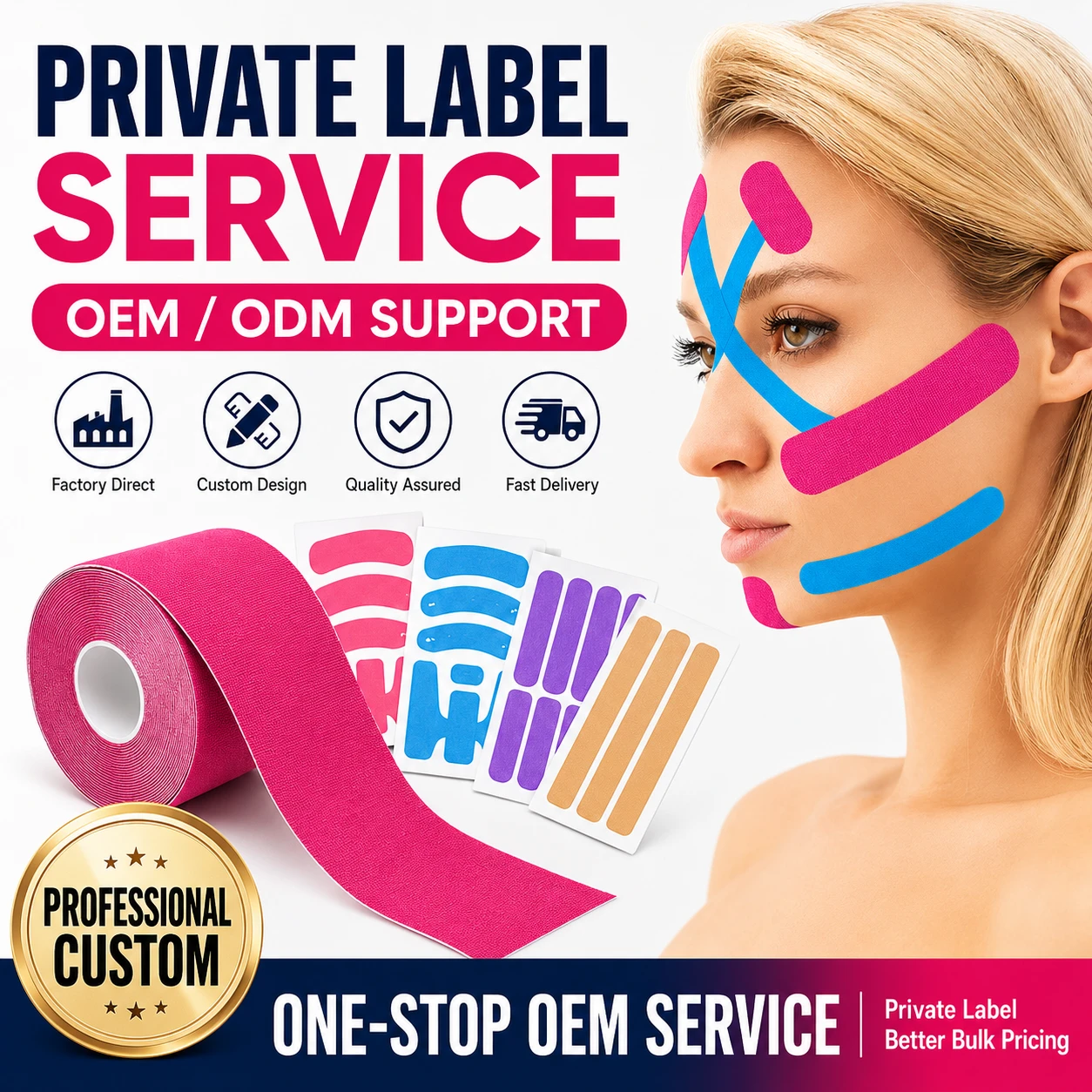
For example, a forehead application may require a relatively horizontal configuration. A brow-tail application may use a diagonal strip. A jawline application may require a longer strip following the contour of the lower face.
Xingda New Material indicates that its roll format can be cut into different shapes, including strips, crescent shapes, and T-shaped configurations.
This flexibility can be valuable for B2B brands because it allows one base material to support multiple product SKUs.
Instead of developing a separate adhesive construction for every application, a brand can potentially use the same tape material with different die-cut shapes and packaging configurations.
This can simplify product development and inventory management.
Roll Tape or Pre-Cut Patches?
One of the first commercial decisions is whether the final product should be sold as a roll or as pre-cut patches.
Roll Format
Rolls provide flexibility.
Users can cut the tape to the desired length and shape, which makes the product suitable for different facial structures and application techniques.
For brands, roll products may also reduce the number of pre-defined shapes required during initial product development.
The disadvantage is that the consumer needs to understand how to cut and apply the tape. Poor cutting technique may affect the appearance of the finished application.
Pre-Cut Patches
Pre-cut patches are easier to use and can create a more standardized user experience.
A brand can develop dedicated shapes for:
Pre-cut patches can also improve packaging presentation and simplify consumer instructions.
The trade-off is that each shape needs to be tested for different face sizes and contours.
For B2B buyers, the choice should be based on the target market rather than simply manufacturing convenience.
Release Liner Selection
The release liner is often overlooked because it is removed before use. Nevertheless, it plays an important role in manufacturing, die-cutting, packaging, and consumer handling.
A release liner must protect the adhesive during storage and transportation while allowing the consumer to remove it without damaging or deforming the tape.
Xingda New Material states that its face tape can use printed glassine release paper and that customized backing paper is available subject to minimum order requirements.
For private-label products, the release liner can also be used as part of the brand presentation.
Possible customization areas include:
The liner should also be compatible with the selected die-cutting process. Poor release characteristics can cause production issues, particularly with small patches or intricate shapes.
Die-Cutting Quality Matters More Than It Appears
Facial contour tape is often supplied as small pieces with curved edges, narrow strips, or customized shapes. This makes die-cutting quality important.
A poorly cut product can have:
Uneven edges
Fiber pull-out
Inconsistent dimensions
Adhesive contamination
Difficult liner removal
Deformed shapes
Xingda New Material notes that correctly controlled cutting can avoid wire drawing, while also acknowledging that the tape material may contain some fibers in larger production runs.
This is a useful point for procurement teams. Sampling should not only evaluate a single finished patch. Buyers should examine samples from actual production conditions to determine whether edge quality remains stable at scale.
Skin Comfort and Product Positioning
Facial products require careful communication.
A B2B supplier should provide accurate material and adhesive information, while the brand selling the finished consumer product should avoid making medical claims that the product cannot substantiate.
Facial contour lifting tape is best positioned as a cosmetic or appearance-enhancement product unless the product has the regulatory basis for a medical claim.
Terms such as "temporarily lifts," "supports facial contours," "creates a more defined appearance," or "helps smooth the visual appearance of selected areas" are generally more appropriate for cosmetic positioning than claims suggesting permanent anatomical change.
This distinction is important for international brands because cosmetic and medical product requirements vary between markets.
The product should also be accompanied by clear use instructions, including appropriate application, removal, storage, and skin-sensitivity guidance.
Water and Sweat Resistance
Consumers do not necessarily use facial tape in controlled indoor environments.
The tape may encounter:
Warm weather
Humid conditions
Light perspiration
Long periods of wear
Makeup
Skin oils
Daily movement
The product page for Xingda New Material describes the face tape as water- and sweat-resistant and recommends wearing it for up to eight hours.
For B2B buyers, these claims should be verified through appropriate testing rather than accepted solely from marketing material.
A practical evaluation can compare adhesive performance under different controlled conditions and measure whether the tape begins to lift at the edges.
Edge lifting is especially important because a tape may remain bonded in the center while becoming visible around the perimeter.
Makeup Compatibility
Makeup compatibility can significantly influence the commercial positioning of facial tape.
Many consumers want to use contouring tape before applying foundation, concealer, powder, or other cosmetic products.
The surface of the tape therefore needs to provide a reasonable base for makeup without causing excessive texture or separation.
Xingda New Material states that its face lifting tape has a makeup-friendly surface and can be used with foundation, concealer, and setting powder.
For product development, this should be tested using the actual cosmetics likely to be used by the target customer.
A brand targeting professional makeup artists may require a different surface finish from a brand targeting everyday consumers.
Testing should consider:
This can help prevent a common problem in which the tape performs well by itself but becomes visually obvious once makeup is applied.
Packaging Considerations for B2B Buyers
Packaging serves several purposes beyond branding.
For facial tape, packaging should protect the adhesive from contamination, moisture, excessive heat, and handling damage. It should also provide convenient access to the tape.
Individually sealed patches can be useful for travel-oriented products and single-use applications. Roll formats may require protective boxes, pouches, or other packaging systems.
Xingda New Material indicates that its face tape can be supplied in individually sealed packaging for portability and on-the-go use.
A B2B buyer should define packaging requirements before mass production.
Important questions include:
What is the individual unit?
How many pieces are included per retail package?
Is the product supplied in rolls or patches?
Does the packaging need to be customized?
What information must appear on the package?
Does the package need multilingual instructions?
How will the product be protected during international transportation?
What batch or traceability information is required?
These decisions affect both production cost and logistics efficiency.
Customization Options for Private-Label Brands
For brands entering the facial tape market, customization can go beyond simply printing a logo.
A complete private-label product can include customization of:
Substrate
Tape color
Tape thickness
Elasticity
Adhesive characteristics
Patch shape
Roll width
Roll length
Release liner
Logo printing
Packaging
Individual wrapping
Application instructions
Xingda New Material states that logo customization is available and gives a stated MOQ of more than 1,000 square meters for this option, with technical confirmation required before production.
This is the type of information B2B buyers should clarify early in a project.
A supplier that can handle both material customization and finished-product processing can reduce the number of external parties involved in development.
What B2B Buyers Should Include in an RFQ
A vague request such as "Please quote facial lifting tape" gives suppliers too little information to provide a meaningful comparison.
A more useful RFQ should include the following specifications.
1. Intended Application
State whether the product is designed for:
Jawline contouring
Brow lifting
Forehead applications
Cheek contouring
General facial use
Photography
Stage makeup
Daily cosmetic use
2. Substrate
Specify whether you prefer:
3. Thickness
Provide a target thickness or acceptable range.
4. Adhesive
Specify requirements for skin contact, adhesion level, residue, and intended wear time.
5. Product Format
State whether you need:
Roll tape
Pre-cut patches
Individual pieces
Sheets
Custom die-cut shapes
6. Dimensions
Provide width, length, diameter, patch dimensions, or other relevant measurements.
7. Appearance
Specify:
Transparent
Nude
Skin-tone
White
Custom color
8. Packaging
Define the expected retail and bulk packaging.
9. Branding
Indicate whether logo printing or private-label packaging is required.
10. Target Market
The destination market can influence documentation, labeling, testing, and packaging requirements.
The more complete the RFQ, the easier it is for suppliers to provide comparable samples and quotations.
A Practical Sample Evaluation Process
Before approving a supplier, buyers should establish a structured sample evaluation process.
Start with material inspection.
Check the tape for:
Surface uniformity
Thickness consistency
Edge quality
Adhesive coverage
Liner quality
Stretch behavior
Visual appearance
Next, evaluate application.
Apply the tape according to the intended instructions and observe:
Ease of positioning
Stretch control
Adhesion
Wrinkling
Edge lifting
Visibility
Comfort
Then evaluate wear performance under realistic conditions.
For example, a sample intended for several hours of cosmetic use can be evaluated during normal movement and in a controlled warm or humid environment.
Finally, evaluate removal.
The tape should be removed according to the intended instructions, and the evaluator should record:
Removal force
Skin discomfort
Residue
Skin appearance
Substrate integrity
This process provides more useful information than simply asking whether the sample "works."
Why Consistency Matters in Mass Production
A sample can perform well while a production batch performs differently if manufacturing controls are insufficient.
Adhesive tapes are multilayer products. Small variations in coating weight, substrate thickness, adhesive curing, release liner performance, and die-cutting can affect the final product.
For B2B customers, consistency is therefore as important as peak performance.
A reliable supply chain should be able to control:
Raw material specifications
Coating parameters
Drying or curing conditions
Slitting dimensions
Die-cutting tolerances
Packaging conditions
Batch identification
Finished-product inspection
Dongguan Xingda New Material Technology Co., Ltd. describes itself as operating an independent and complete production chain covering adhesive tape research, development, production, and sales. The company also supplies multiple adhesive tape categories, including sports tape, kinesiology tape, athletic tape, cloth-based adhesive tape, double-sided adhesive tape, and customized special adhesive tapes.
For buyers developing multiple adhesive products, this broader material and processing capability can be relevant because facial tape may be only one part of a larger sourcing program.
Facial Tape for Different B2B Business Models
Different buyers have different priorities.
Beauty Brands
A beauty brand may focus on appearance, packaging, application experience, and compatibility with its existing cosmetic range.
For this buyer, custom patch shapes, private-label packaging, and makeup compatibility may be more important than simply achieving maximum adhesion.
Distributors
Distributors usually need products that can serve several customer segments.
A roll-based product with flexible cutting options may be attractive because it can support different applications without maintaining too many SKUs.
Cosmetic Tool Brands
A company selling beauty tools may use facial contour tape as a complementary product.
In this case, packaging and cross-selling potential may be important. For example, the tape could be bundled with facial rollers, makeup tools, contouring products, or travel beauty kits.
Professional Makeup Suppliers
Professional users may prioritize discreet appearance, reliable adhesion, easy removal, and compatibility with different makeup systems.
A product intended for photography or stage applications may also require extensive visual testing.
Private-Label E-Commerce Brands
Private-label sellers often need a relatively complete solution, including product development, packaging, logo customization, and consistent replenishment.
For these buyers, supplier responsiveness and customization capability can be just as important as the tape itself.
Common Mistakes When Sourcing Facial Contour Lifting Tape
Several purchasing mistakes appear repeatedly in adhesive product sourcing.
Focusing Only on Price
The cheapest tape may not provide the best commercial value.
If the adhesive fails, the tape becomes visible, or the consumer finds removal uncomfortable, the apparent purchasing savings can be outweighed by returns, complaints, and poor reviews.
Testing Only One Sample
One sample cannot demonstrate production consistency.
A better approach is to test samples from different production batches when possible.
Ignoring the Liner
A poor release liner can make an otherwise good tape difficult to use.
Not Testing Makeup Compatibility
If the final product will be marketed as makeup-friendly, this should be tested before product approval.
Using Generic Dimensions
Facial tape applications vary considerably. A single size may not be suitable for every market.
Overlooking Instructions
Application technique directly affects performance. Clear instructions can improve the consumer experience without requiring changes to the adhesive formulation.
Making Excessive Cosmetic Claims
Marketing claims should reflect the actual function of the product and the evidence available for those claims.
For B2B brands entering multiple markets, regulatory review should be incorporated into product development rather than addressed after packaging has already been printed.
How to Build a More Practical Facial Tape Product Line
A new brand does not necessarily need ten different facial tape SKUs at launch.
A more practical approach is to begin with a small number of clearly differentiated products.
For example:
Product A: General Facial Tape Roll
A flexible roll that allows consumers to cut customized strips for different facial areas.
Product B: Jawline Contour Patches
Pre-cut pieces designed around the lower-face application area.
Product C: Brow and Upper-Face Patches
Smaller pieces designed for targeted applications.
Product D: Professional Makeup Tape
A discreet version positioned for photography, makeup, events, or professional use.
The exact product portfolio should be based on market feedback and application testing.
Using a common base material where practical can also simplify procurement and inventory planning.
Storage and Transportation
Adhesive products are sensitive to storage conditions.
Although exact storage requirements should be established according to the selected adhesive system and supplier's technical documentation, buyers should generally consider exposure to excessive heat, humidity, direct sunlight, contamination, and compression.
International transportation adds another consideration.
A B2B buyer should assess how the tape behaves after transportation and storage rather than testing only fresh samples.
After a defined storage period, inspect:
Adhesive tack
Liner release
Tape appearance
Edge condition
Substrate elasticity
Packaging integrity
This is especially important when developing products for international distribution.
Questions to Ask a Facial Tape Supplier
Before placing a production order, buyers can ask the supplier:
What substrate options are available?
What thickness ranges can be supplied?
Is the material unidirectional or bidirectional stretch?
What adhesive system is used?
What skin-contact testing is available?
What is the recommended wearing time?
How does the product perform under humidity and perspiration?
Can the tape be supplied as rolls or pre-cut patches?
Can custom shapes be die-cut?
Can the logo be printed?
What release liner options are available?
Can packaging be customized?
What are the MOQ requirements?
Can samples be produced before mass production?
What quality-control procedures are used during production?
Can the supplier support other adhesive tape categories?
These questions help turn a general supplier inquiry into a technical sourcing discussion.
Why an Integrated Adhesive Tape Supplier Can Simplify Development
Facial contour lifting tape involves several processes that need to work together.
Material selection affects coating. Coating affects adhesion. Adhesion affects application and removal. Die-cutting affects finished shape. Packaging affects product protection and consumer handling.
When these processes are managed through disconnected suppliers, communication becomes more complicated.
An integrated supplier can potentially coordinate material selection, adhesive coating, slitting, die-cutting, customization, and packaging through one production chain.
For brands developing several tape products, this can make supplier management more efficient.
Dongguan Xingda New Material Technology Co., Ltd., operating under the Xingda New Material brand, focuses on adhesive tape research, development, production, and sales and offers both standard adhesive tape products and customized tape solutions. Its product portfolio covers sports and personal-care-related adhesive applications as well as special adhesive tape materials.
The company's face tape range is one example of how adhesive tape technology can be adapted for cosmetic applications.
What Makes a Good Facial Contour Lifting Tape?
There is no single specification that defines a good facial contour lifting tape.
Instead, a commercially viable product should provide a balanced combination of:
Controlled adhesion: The tape should remain attached for its intended use without unnecessarily aggressive removal.
Low visibility: Thin construction, suitable color, and appropriate edge design can help the tape remain discreet.
Conformability: The material should follow facial contours without excessive wrinkling.
Suitable elasticity: Stretch characteristics should support the intended application technique.
Skin-contact suitability: The adhesive and substrate should be selected with facial skin requirements in mind.
Practical handling: Consumers should be able to remove the liner, position the tape, and remove it without unnecessary difficulty.
Makeup compatibility: If marketed for cosmetic use, the surface should be evaluated with representative makeup products.
Consistent manufacturing: Finished dimensions, adhesive coating, and material properties should remain stable between batches.
Customization capability: Brands should have options for patch shape, size, liner, printing, and packaging when needed.
For B2B procurement, the best supplier is therefore not necessarily the one offering the lowest unit cost. It is the supplier that can consistently produce a specification suitable for the intended market.
Final Considerations for B2B Buyers
Facial contour lifting tape is a relatively simple-looking product, but its performance depends on a carefully engineered combination of substrate, adhesive, thickness, stretch, liner, die-cutting, and packaging.
When evaluating suppliers, buyers should move beyond basic questions such as "How strong is the tape?" and "How much does it cost?" A better evaluation asks whether the material is suitable for facial skin, whether it remains discreet during use, whether the adhesive performs consistently, whether the product can be customized, and whether the supplier can maintain the same specifications during volume production.
For companies developing private-label facial tape, cosmetic accessories, beauty tools, or professional makeup products, these factors can have a direct impact on product quality and customer experience.
Xingda New Material provides face lifting tape in thin, high-elasticity constructions with options including non-woven fabric or transparent polyurethane substrates, skin-contact adhesive systems, roll or pre-cut formats, and customized processing. The supplier also supports broader adhesive tape categories, allowing buyers to discuss facial tape alongside other adhesive tape requirements.
A practical sourcing process should begin with a clearly defined application, followed by material samples, technical evaluation, application testing, packaging confirmation, and production validation. This approach gives B2B buyers a stronger basis for selecting a facial tape that fits the actual requirements of their brand and customers.
For companies looking for a reliable source of facial contour lifting tape, the most useful next step is to provide the intended application, substrate preference, tape dimensions, target market, packaging requirements, and customization needs. With these details defined in advance, the supplier can recommend a more appropriate construction and prepare samples for evaluation rather than relying on a generic tape specification.
Xingda New Material can support customized adhesive tape development for businesses that need specific dimensions, shapes, materials, adhesive characteristics, branding, or packaging. This makes the development process more practical for B2B customers who are building a new facial tape product or expanding an existing personal-care adhesive product line.